
The diversity of music in Brazilian Zouk is beautiful
Many people come to Brazilian Zouk because they like the music. Depending on where they first see the dance, that music could be very different! One of the best things about Brazilian Zouk is that we dance to many music genres, each with its own vibe. The dance’s ability to adapt to so many music types is a big part of what makes it so dynamic and expressive.
At the same time, a lot of newer dancers struggle with dancing to various rhythms. In Bachata music, the percussion rhythms always follow similar patterns, so what students learn with in class is very similar to what they dance to in the party. But in Brazilian Zouk, students might learn to dance with music with a Zouk beat (the boom chik chik we all know and love), but they get to the party and have to figure out how to step to totally different beats. It’s not surprising that students are often confused and unconfident or unable to stay on time!
We could remove a lot of the confusion if we only played music with a very clear zouk beat, right? And some parties or DJ sets are like that. My opinion is that the zouk beat is an important pillar of the dance, but it’s a little boring to dance to only this one rhythm when it is so adaptable to other rhythms. Others may have a different opinion and that is totally fine (but I would not let them DJ at any party I organize 😅).
Music and your brain
Finding the beat and understanding structure in music is an exercise in pattern recognition. First you need to spend some time actively thinking about these and consciously seeking them out. This is easier to do when you are *not dancing*.
When you are new to dancing and unfamiliar with the music, executing basic steps already takes a lot of brainpower. Analyzing music that is unfamiliar also takes a lot of brainpower. Trying to do both at once will probably overload your brain, so one or both functions will degrade or shutdown entirely. That’s one reason students can usually do the movement better in class with no music or when following the teacher vs doing the same movement in a social while dancing to music.
When you are more familiar with your movements, those take less brainpower, and you can use more brainpower for analyzing the music. When you understand music structure and have trained pattern recognition on more music, you can use more brainpower for thinking about more complex movements, creative expression playing with the music rather than just stepping on the obvious beats, etc.
What are we doing here
I’m going to give you tools to understand common types of music. Practice that (while not dancing) until you have a decent understanding and can reliably understand the music structure when you focus on it. Then you can listen to lots of danceable music while you are working/studying/exercising etc) and passively let your brain become better at finding the patterns. The more you expose yourself to different rhythms, the faster and more efficiently you will pick up the beat until you can do it without thinking about it. This will reduce your stress and unlock a lot of enjoyment and creative potential in your dance!
In most parties today dancers have to understand how to step to different rhythms so that we can dance with a partner *together*. Dancers need to understand
a) how to find the beat
b) where our steps fit on the beat
c) how popular 4/4 music is structured (in phrases)
I taught a class on this in my studio Flow Taipei yesterday, and I’ve decided to share a lot of the information and materials here for
1) any dancers that feel stressed out or confused by the music when they dance
2) local teachers that would like some ideas about how to explain this to their students
This might get a little technical and nerdy, but bear with it and get the basic concepts and with practice it will be well worth it.
* I’ve been dancing Brazilian Zouk since 2018 and DJing since 2020. I’m not a professional musician. This is the understanding that I use to dance and DJ and I’m doing my best to share it in a way people can understand so that more people have access to this information even if they can’t get it from teachers in their area. If I say something inaccurate, please forgive me.
Let’s go 🤙
Find the downbeat
The first step to being able to dance to a song is to find the downbeat. Most 4/4 music has a constant pulse, even if there is no percussion (drums). Listen to the song and find the pulse, the rhythm that makes you want to nod your head. I think the easiest music to feel this is House because the rhythm is usually four on the floor- the bass drum hits on every downbeat. Try listening to some of the songs on this Nitefreak Afrohouse playlist and find the downbeat-
Pretty much everyone can find the downbeat in music like this. If you can’t find it in this music, watch people around you moving to this music and see if you can pick up the feeling that way.All right, got it? Move on to music using zouk beat. Let’s use this Kizomba 2026 playlist- play through some songs and see if you can find the downbeat:
Once you have that. Try finding the downbeat in RnB. RnB has way more variations in rhythm, so you can’t rely on the bass drum always hitting the downbeat. Do your best to find the pulse in some of these songs:
Let’s look at how we step. Depending on who is teaching we either have four or five dynamics (stepping patterns). But to make this easier, let’s simplify this to two dynamics: Traditional (slow quick quick) and RnB (quick quick slow). How do we decide which one to use and when? To keep it simple, it’s really just how we choose to interpret the music, although we tend to use the traditional dynamic more with music like Zouk and Kizomba and the RnB more with music like RnB.
1) Impulse- generates the momentum that we use for the rest of the half basic; usually this is a traveling step
2) Control- catches and stabilizes the momentum
3) Ground- prepares for the next impulse step
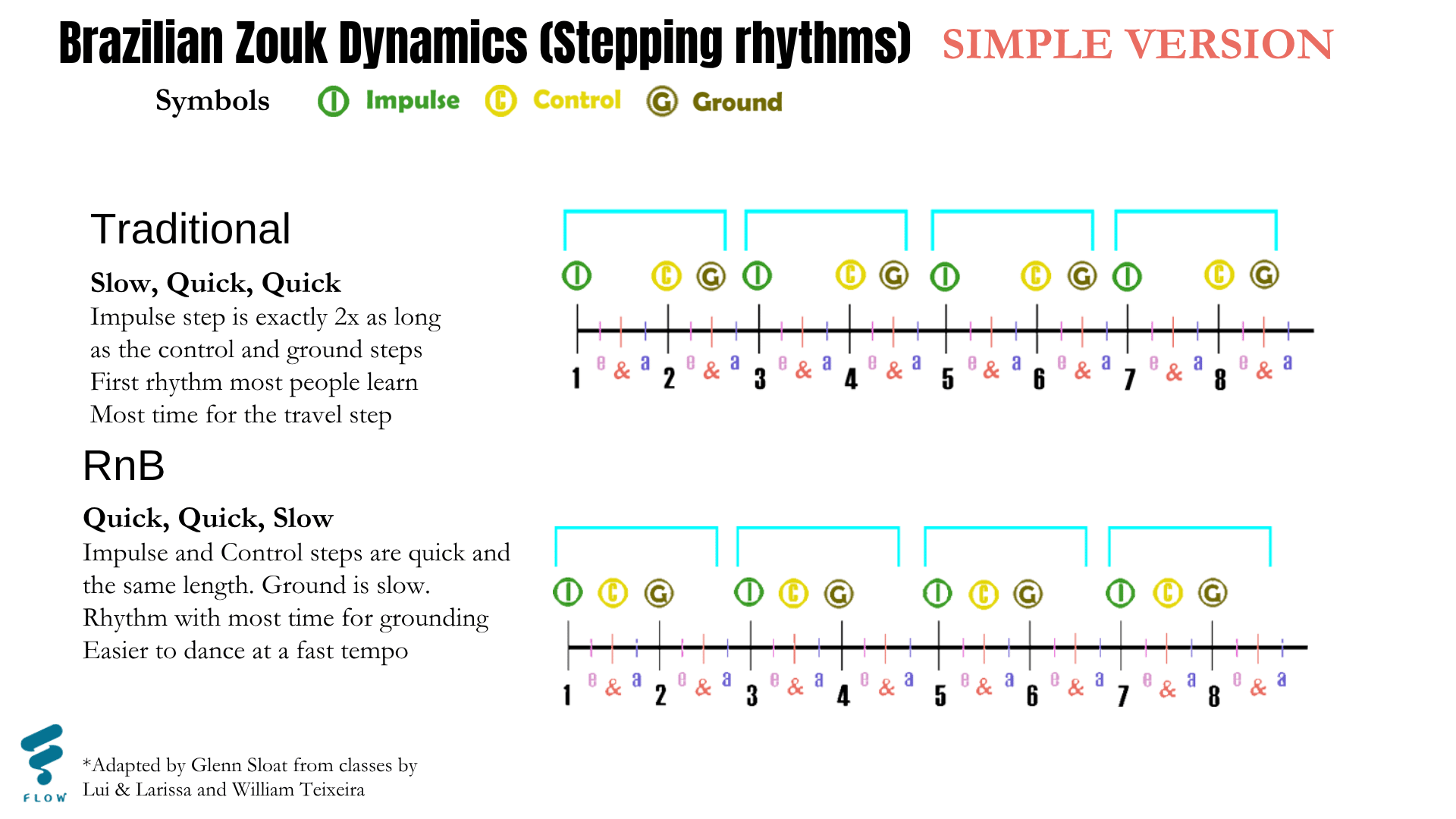
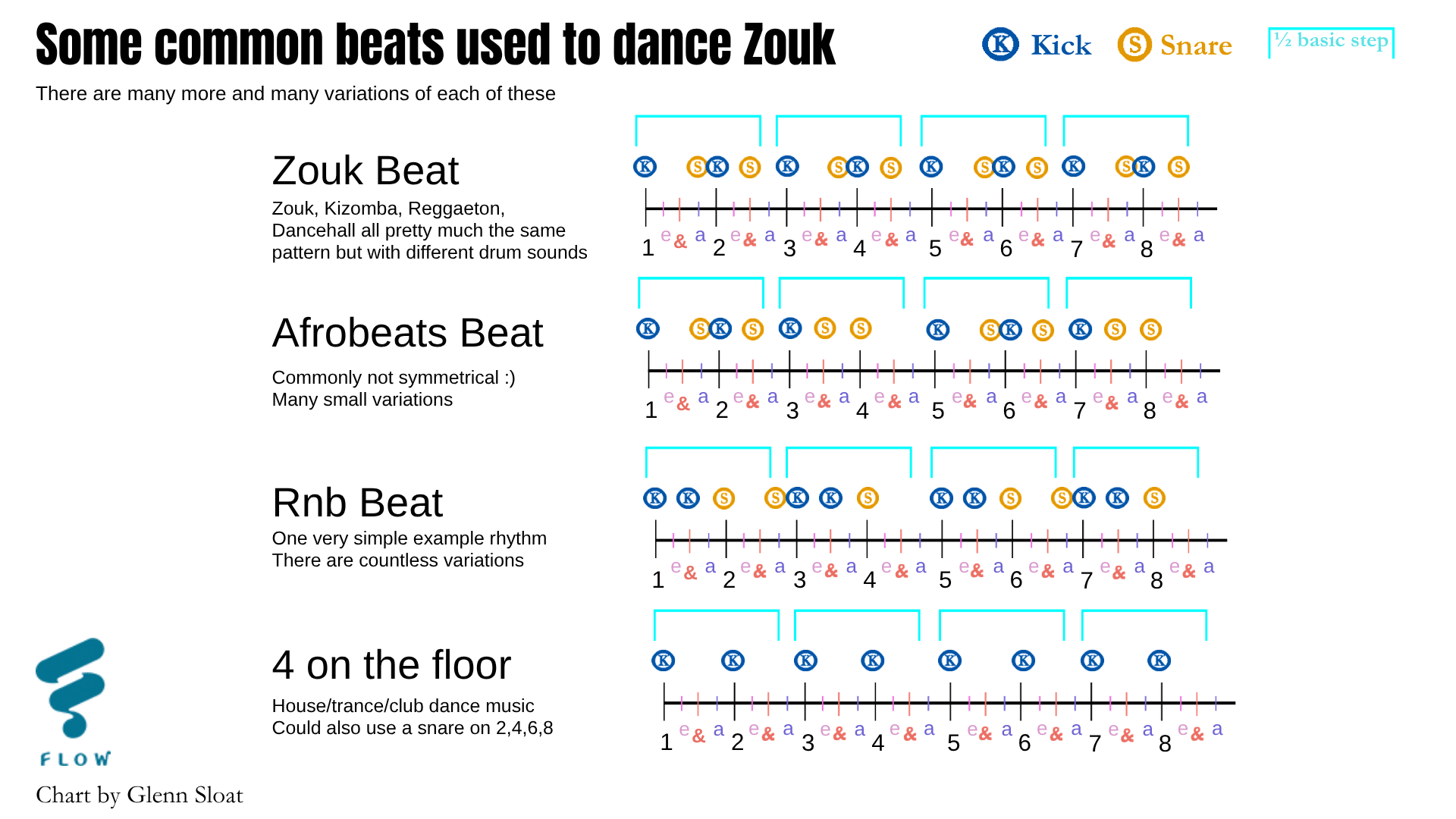
So basically, to dance to any of these rhythms, you just need to be able to find the 1, 3, 5, or 7 for your impulse step. The most important of these numbers is the ONE. Basically to find a 1, first find the downbeat as we did above, and then listen for an obvious change on a downbeat. The change could be the appearance or disappearance or change in pattern or energy of the vocals, instruments, or percussion (rhythm). Looking for a big change on a downbeat is a very reliable way to find a 1, and then you just have to keep the rhythm and the phrasing. As you practice with more music this will become easier and easier 🙂
I made this playlist with music videos so that you can not just hear the music but also see how the music is expressed in the video. For music to have any meaning in our dance, we should at least have a sense of the vibe. Go through these videos and see how Zouk, Kizomba, Reggaeton, Afrobeats, and Dancehall all have similar rhythms but very different vibes!
This is a mix I recorded of most of the songs in the playlist above (some substitutes). This is recorded with the songs played at danceable speeds. Use this to practice finding the beat and adapting your dance to many different rhythms and energies
Find DJs you enjoy and listen to lots of music to train your ears
https://www.mixcloud.com/DJRxZouk/
https://soundcloud.com/kakahproznl
https://soundcloud.com/djstefg
Zouk
Ghetto Zouk
Zouk Love
Kizomba
Tarraxo
Tarraxinha
Afrobeats
Afrohouse
Dancehall
Reggaeton
Latin Pop
Brazilian Pop
RnB
Slow Jams
Neo Soul
Acoustic
Lyrical
Pop
And if you are looking for music to dance lambada, a few Spotify playlists:
Musicas para dancar Lambada – Rhawann
Ariel & Leticia Lambada
Iago Hassuike Lamba